Author: Akshay Uppala

  • The Truth About Beach Riding: Tides, Waves, and Reading the Sand

    The Truth About Beach Riding: Tides, Waves, and Reading the Sand

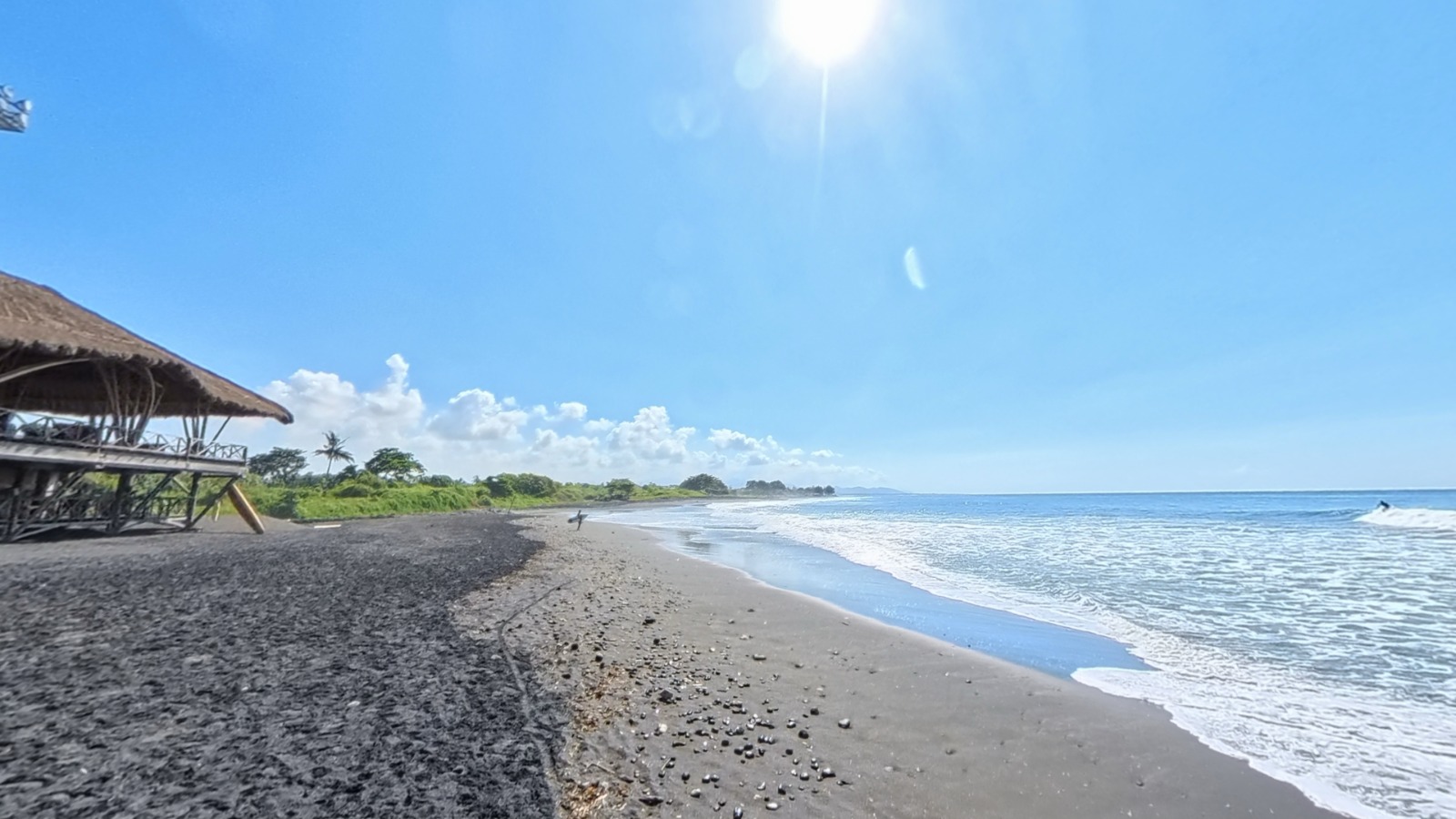
    The social moment is pervasive: a full gallop, reins in one hand, sea spray and sun, no helmet, no cares as the long stretch of empty beach-side sand and crashing sea flashes by. The image is a gold-mine for tour operators, with beach riding sold as pure, wild, and enchanting fun. Yet talk to the guides and operators who offer coastal trail rides for a living, and a very different story is told. The beach is one of the most deceptive environments you can ride. Between shifting tides, broadside waves, glaring reflective sunshine, sand that is suddenly deep, and tidal runoffs cutting across your path, your dream ride can quickly turn challenging. The reality: a good coastal ride isn’t about letting go — it’s about paying closer attention. 

    The Romance vs. the Truth 

    On Instagram, the shoreline looks like a flat, open racetrack where nothing can go wrong. The truth on the ground is a working, unpredictable landscape. 
     
    When you ride out onto a coast—whether along the volcanic sand of Bali, the islands of Thailand, or anywhere else—you are sharing that space with breaking swells, local fishing boats, village dogs, and families out walking. More than that, you are sitting on an animal that perceives the beach very differently than you do. The wind drowns out your voice, the sound of the crashing surf builds excitement, and that vast open horizon triggers an ancient instinct in horses to run. 
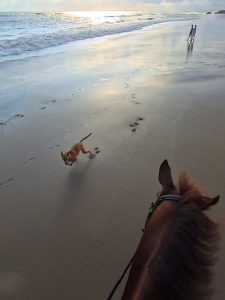
    When passing local fishermen working in the surf, families on the shore, or the frontage of a beachfront resort, a thoughtful rider drops smoothly to a walk. Slowing down is basic courtesy to the community whose workspace you are crossing, but it is also essential safety: it gives your mount the mental bandwidth to absorb sudden distractions—like a loose dog or a tumbling beach umbrella—without spooking at speed. 

    When an operator promises ‘fast beach gallops for absolute beginners with zero experience,’ that’s your cue to pause. In open coastal air, horses feed on each other’s energy. If one speeds up, the rest want to follow. Without a solid, independent seat and an established connection through the reins, what was supposed to be a scenic holiday canter can quickly turn into a passenger ride you can’t steer. 

    Why Horses Trip: What the Ground is Doing Beneath You 

    Ask any seasoned guide why beach rides have more sudden stumbles than woodland trails, and they won’t blame clumsy horses. They’ll point straight at the sand. 
     
    Most of us assume wet sand is as solid as an arena floor. But sand soaked with ocean water is alive and moving. When a horse strikes wet sand at a canter, the impact pushing down forces water up between the tightly packed sand grains. For a split second, the solid wet-sand patch turns from firm to thick liquid. A horse that felt sound underfoot on one stride suddenly punches inches deeper on the next. The front leg sinks, the shoulder dips, and the horse stumbles over its own stride. 

    There’s another strange quirk of wet coastal sand: suction. When a hoof drives into wet, fine silt, lifting it creates a momentary vacuum seal. The hoof takes just a fraction of a second longer to leave the ground, and because the horse’s large frame is still moving forward in a canter, that delayed step acts like an invisible tripwire, causing a sudden knee buckle. 
     
    And then there is the rider. We often make this harder on our horses without even realizing it. When riding in open country, it’s quite natural to lean forward into a light seat. But when your weight tips onto the withers, you put nearly three-quarters of your combined weight onto the horse’s front legs. The unevenness of load compounds the impact of the horse hitting a soft pocket of sand or a suction patch: the horse has no balance left in reserve to catch itself. Keeping your upper body tall, your seat grounded, and your weight distributed back helps the horse recover cleanly whenever the footing shifts. 

    “A horse has incredible forward power, but almost zero lateral balance against moving water. Catching a wave sideways doesn’t just splash—it unbalances legs.” 

    Riding the Surf: Why Swell Direction Matters 

    Wading through surf looks effortless on camera, but ocean water doesn’t behave like a gentle river. A river flows in one direction; ocean waves hit with lateral force, lift, and then retreat with a strong undertow. 
     
    One of the most important habits a beach guide teaches you is never to let a breaking wave catch your horse broadside. A horse’s legs are built to carry weight forward and back; they have very little strength against sideways pressure. When a rolling knee-high wave hits a horse from the side, the water pushes against the legs while simultaneously washing the sand out from under the hooves. With a rider sitting up top, that sideways impact can easily buckle the horse’s knees and knock both of you off balance into the foam. 
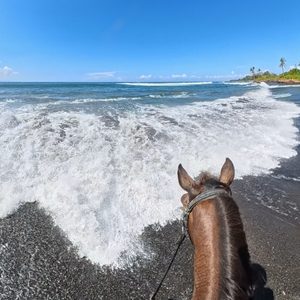


    The simple rule in the surf is to meet the water squarely: 

    • Turn toward the wave: When an incoming swell approaches, turn your horse’s shoulders straight into it. Meeting the water head-on lets the chest part the wave while keeping all four legs square and stable under the body. 
    • Angle with the retreat: As the wave breaks and rushes back out to sea, turn the horse smoothly away or angle diagonally with the water. Never let the retreating sea drag sideways across the back of the legs—that pulling feeling as the sand slides away beneath them can startle even a calm horse into stepping backward blindly. 

    The Rivulet Reflex: Reading the Sand Ahead 

    Another surprise waiting on a beach canter is the tidal rivulet—the shallow drainage streams carved across the sand as the tide recedes. 
     
    From the saddle at a canter, a 3- or 4-foot-wide stream looks like a flat puddle. But to a horse’s eyes, moving water cutting through sand can look like a bottomless trench. They cannot tell if it is two inches deep or a sudden drop-off. When horses approach a stream of water at speed, they typically react in one of two ways: 
     
    1. The sudden anchor: The horse drops its head, sits back on its hocks, and slides to a dead stop from a canter. If you are leaning forward with loose reins, momentum will send you straight over the shoulder. 
     
    2. The unannounced jump: The horse coils and launches over the rivulet as if it’s a cross-country ditch. If you aren’t expecting it, the sudden upward thrust leaves you behind, coming down hard on the saddle or losing a stirrup. 
     
    The fix is simple: look ahead. An attentive rider reads the beach fifty yards out. When you spot a water channel or a dark drainage cut, bring your horse back to a balanced trot or a steady walk. Let the horse lower its nose, check the depth, and step calmly across on a light rein before asking for a canter again. 

    Optical Vertigo: Why Horses Freeze in Foaming Water 

    If you’ve ever stood in retreating surf and felt like you were sliding backward, you’ve experienced what horses feel. Horses rely heavily on a stable horizon to balance. When a wide sheet of white foam rushes rapidly past their legs back out to sea, their eyes perceive the movement, but the shifting sand underfoot makes them feel like the earth itself is sliding away. 
     
    When this happens, a horse will often freeze, plant its front feet wide, drop its head to its knees, and shake its ears in confusion. Hitting or kicking a horse in this moment only adds panic to disorientation. The best response is quiet reassurance: keep your eyes fixed on a solid point on land—a headland or tree line—keep a gentle, supportive leg on, and quietly guide the horse’s head back toward dry ground until its balance resets. 

    The Camber Problem: Straight Lines on the Beach Aren’t Flat 

    Most beaches aren’t level; they slope toward the sea. Cantering a long, straight line parallel to the water means your horse is constantly traveling on a slant—the inside leg stepping higher than the outside leg. 
     
    Over a kilometer or two, that constant tilt puts uneven strain on joints and hocks and makes it easy for a horse to brush its own legs or clip a heel. Good guides won’t hold one endless straight canter along the slope; they’ll vary the path, incorporate walking breaks, and give horses time to travel squarely. 

    Why the Tide Table Comes First 

    A reputable coastal stable never schedules rides based on vacation breakfast hours or sunset photo preferences. They schedule strictly around the tide, the heat, the weather, and local conditions. 
     
    When the tide goes out, it leaves behind a wide strip of firm, packed wet sand. This is the only ground suitable for active work: it’s springy, clean, and supports the horse’s weight without giving much way. Up higher on the beach, the dry sand is deep, loose, and heavy. Working a horse in deep, dry sand at anything more than a walk is exhausting and strains tendons. 
     
    At high tide, that firm, packed strip is completely submerged. If an operator tells you they can run an active beach ride at peak high tide, they are either going to slog through heavy dry sand or squeeze between breaking waves and sea walls. An ethical stable checks the tide chart first: if low tide is at 6:30 AM, you ride at dawn. If low tide falls during a sun-blazed late afternoon, they ride inland trails instead. 

    The Real Magic of Coastal Riding 
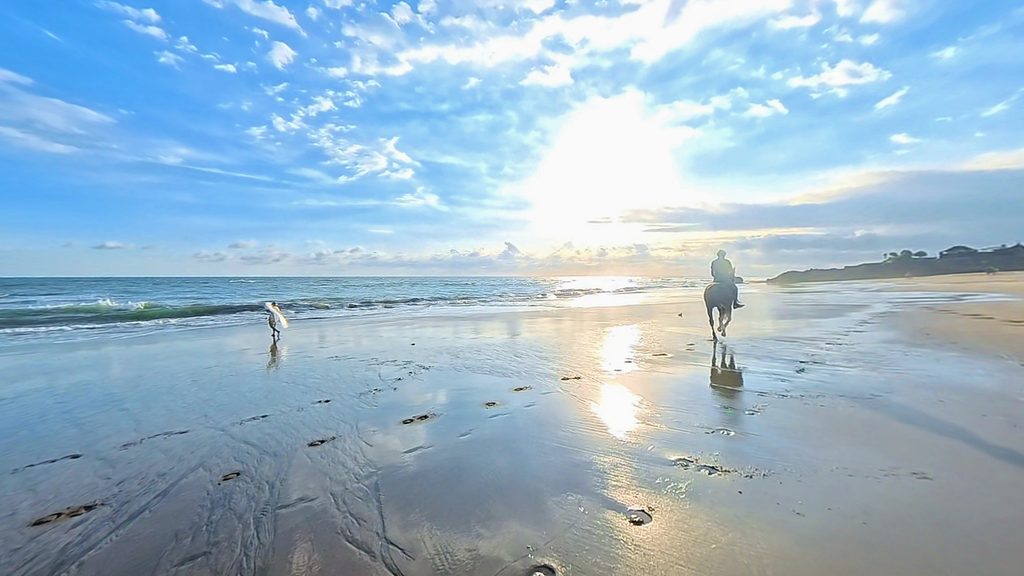
    Riding along an ocean coast is one of the most memorable experiences equestrian travel offers—not because it has to be a reckless gallop, but because it asks you and your mount to ride in partnership with a powerful natural world. 
     
    When you understand how the tides shape the footing, how to guide a horse through the swell, and how to read the sand ahead, the ride becomes effortless and safe. You aren’t fighting the elements for a photograph; you are moving with the rhythm of the sea, riding with quiet confidence, and giving the horse the care and attention it deserves. 
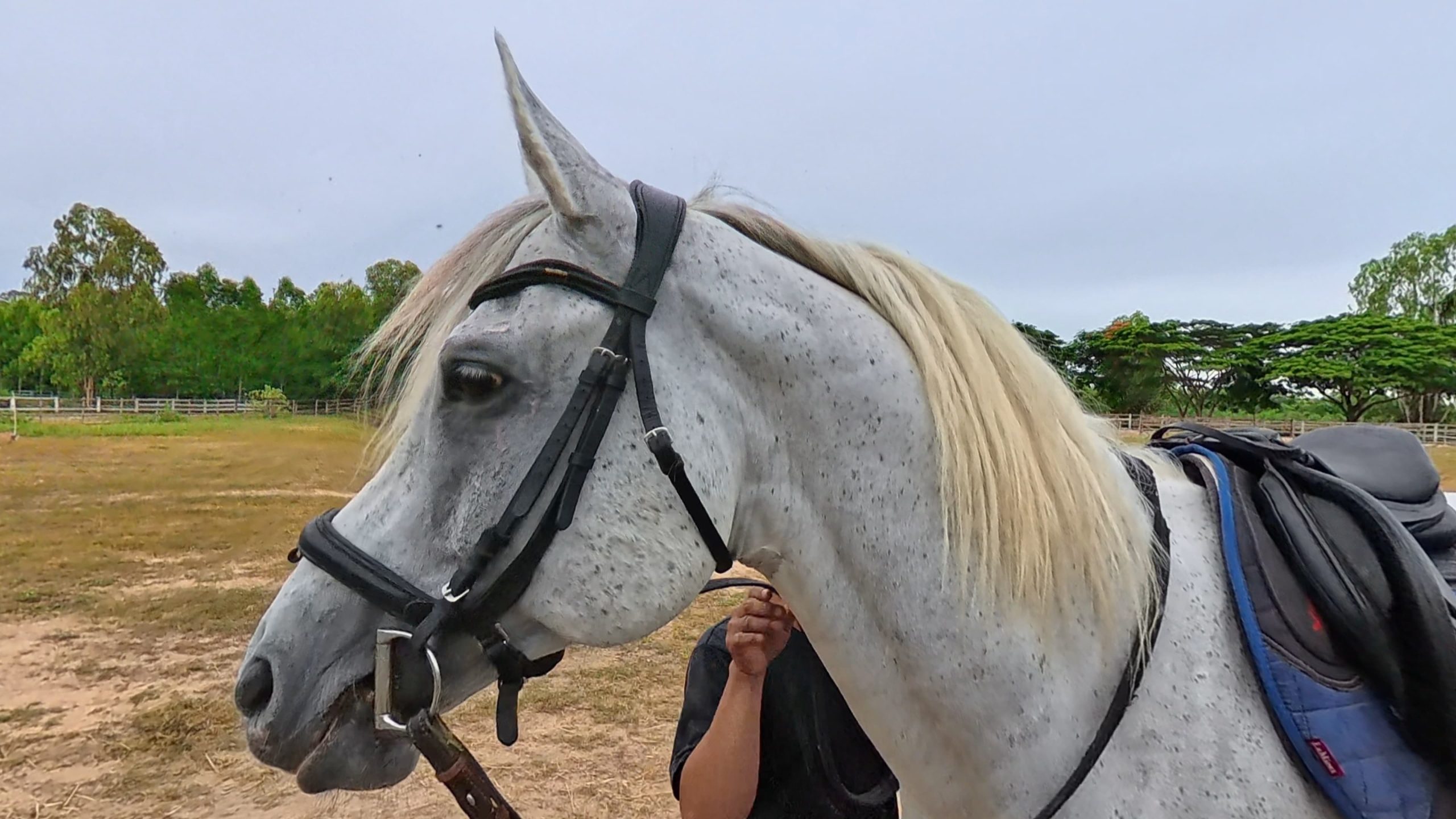
  • First 5 Things to Do When You’re Handed a Horse

    First 5 Things to Do When You’re Handed a Horse

    The lead rope is in your hand. Now what? Most first-time riders have no idea what to actually do in the sixty seconds between being handed a horse and being asked to mount. Seasoned riders know these steps too — but on a tight schedule, in a new country, with a horse they’ve never met, it’s easy to skip straight to the stirrup. Here are the first five things a confident, respectful rider does, every time, no matter how long they’ve been riding.

    The Moment Everyone Skips

    Riding-holiday content is full of footage from the saddle — cantering on the beach, weaving through jungle trails. Almost none of it shows the sixty seconds before that: standing next to a horse for the first time, lead rope in hand, deciding what to do next.

    That moment matters more than it looks. It’s when a horse decides whether to trust you, and when you get your first real information about the animal you’re about to ride. Ironically, it’s often the more experienced riders who skip this fastest — muscle memory takes over, and years in the saddle can make the handoff moment feel like a formality instead of the first real information you’re getting about this particular horse. Here are the first five things worth doing in that window, whether it’s your first ride or your thousandth.

    1. Ask Which Horse, and Why

    Before you approach, ask the guide why you’ve specifically been matched with this horse. A well-run operation has a clear answer — your size, your experience level, the horse’s temperament and rank within the herd — and will explain it without hesitation.

    Operators who can’t or won’t explain their matching process are telling you something about how much thought goes into their overall welfare and safety practices. This isn’t a trick question; it’s the same question an experienced rider asks out of habit, every time, at every yard — regardless of how many horses they’ve ridden before.

    Technical Focus: ‘What made you choose this one for me today?’ A guide who lights up answering this is usually a professional who knows their herd intimately.

    2. Approach From the Shoulder, Slowly

    Walk toward the horse at an angle aimed at the shoulder — never straight at the face, and never from directly behind. This is the one approach angle where the horse can see you clearly with both eyes and won’t be startled by your sudden appearance.

    It’s a small detail, but it’s the first sign to both the horse and anyone watching that you know what you’re doing. Even riders who’ve done this a thousand times will occasionally walk straight up to a horse mid-conversation with a guide, phone in hand, mind elsewhere. It’s often the first habit that slips when you’re distracted — worth noticing in yourself as much as teaching to someone new.

    Observation Note: Horses have a wide field of monocular vision but a blind spot directly ahead and directly behind. The shoulder is the natural vantage where they can track you with binocular focus the whole way in.

    3. Let the Horse See and Smell You First

    Pause a few feet away before making contact. Horses build trust through calm, unhurried first impressions, and skipping straight to touching the reins or tack denies the animal the chance to actually register who you are.

    A few seconds of stillness here does more for the relationship than anything you’ll do once you’re in the saddle. If the horse leans in to investigate you, that’s a good sign — let it happen at its own pace rather than reaching out to meet it halfway.

    Field Check: Keep your hands still and down at your side rather than shoving an open palm toward a strange horse’s muzzle. Let the animal extend its neck and smell your knuckles or sleeve on its own terms.

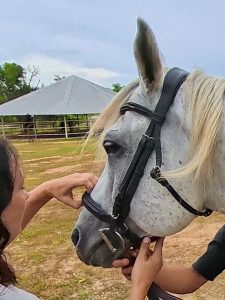
    4. Greet the Neck and Shoulder, Not the Face

    A gentle hand placed on the neck or shoulder is a natural, low-pressure greeting. Reaching straight for the face or ears — especially from someone the horse has never met — can feel intrusive before trust has been established.

    Let the first touch be somewhere neutral. There will be plenty of time for a face rub once the horse has decided you’re worth relaxing around — usually within the first minute, if the first four steps have gone well.

    Observation Note: Feel the tone of the neck musculature under your palm. A horse that tenses its brachiocephalicus muscle or braces sharply at initial contact is signaling underlying apprehension that warrants quiet patience.

    5. Take Your Unhurried Moment Before the Stirrup

    Once you’ve said hello, stop again. Watch the ears, the eyes, the breathing settle. This short check-in — the same ritual experienced riders use before every single ride, regardless of how many times they’ve ridden that particular horse — is what actually turns ‘being handed a horse’ into genuinely assessing the animal you’re about to trust with your safety for the next few hours.

    This is the same grounding pause covered in more technical depth in our companion guide on tack mechanics and saddle fit — the point where a rider moves from meeting the horse to actually reading it.

    Related Reading: For the complete technical check — saddle balance, gullet clearance, and girth tension — see our companion guide: ‘The Pre-Mount Protocol: Ten Technical Checks Before the Saddle.’

    Why the First Five Steps Set the Tone

    None of this requires special skill. It requires slowing down in a moment most tourists are rushed through – often because a schedule is tight, or because no one has ever told them there’s anything to do besides climb on.

    For a first-time rider, these steps are a first lesson. For an experienced one, they’re a discipline – the same reason a pilot runs the same pre-flight checklist on their ten-thousandth flight as their first. Those first five actions are also a quiet test of the operation you’ve booked with: a stable that gives you space and time for this handoff, and staff who explain their matching process without being asked twice, are showing you the same welfare-first culture that should be present throughout the rest of your ride.

    A good guide will never rush this moment, and a good rider will never skip it – no matter how many horses they’ve met before. If the pace of your arrival makes any of these five steps feel impossible – no time to ask, no space to pause – that alone is worth a quiet word before you mount.

  • The Asian Advantage: Why Riding Here Changes You

    The Asian Advantage: Why Riding Here Changes You

    Before the heat rises, the valley is still wrapped in mist. Your horse steps deliberately along the red earth track, picking a line past exposed teak roots where the trail begins to climb into the limestone hills. High above, the jungle canopy filters the first pale light; forty minutes later, the trail opens onto terraced hillsides, crosses a shallow gravel stream where water splashes cool against the horse’s fetlocks, and skirts an old wooden spirit house resting quietly beneath a banyan tree, draped in weathered silk ribbons.

    For riders who travel, the default map has long been predictable: the manicured turf and open canters of Europe, the private sporting estates of Ireland, or the wide-sky cattle ranches of Montana. Those traditions are magnificent, and they belong exactly where they are.

    Asia does not compete with them by trying to mimic them. It offers something entirely distinct.

    Here, the landscape is never just a scenic backdrop for a canter photograph. It is an active partner that dictates your pace, tests your horsemanship, and quietly rewrites your understanding of what a riding journey can be.

    The Ground Speaks First

    In a groomed arena or along an estate track, riding can easily become an exercise in pace and mechanical control. Asia’s terrain asks for something older: trust, stillness, and observation.

    A mountain trail through Northern Thailand or the Indonesian highlands changes footing every fifty strides. A horse reads wet granite, bamboo roots, slick river clay, and sudden rainforest gradients long before you register them. On tidal stretches along the coast, the packed wet sand of low tide offers firm galloping ground, while soft dry sand higher up demands caution to protect unconditioned tendons.

    On trails like these, your job as a rider shifts. You learn to stay centered in the saddle, keep your rein contact quiet, let the horse drop its head to place its feet, and accept that an unhurried walk down a steep jungle descent is not a delay—it is horsemanship in its purest form. The terrain forces you out of your head and into the horse’s movement.

    The Living Canopy—Beauty and Bite

    To ride here is to be swallowed by a botanical world that is both breathtaking and utterly indifferent to you. You push beneath massive clumps of giant bamboo arching like cathedral vaults overhead, brushing past broad wild banana leaves dripping with night dew and giant bird’s nest ferns perched high in the crooks of ironwood and strangler figs. The air smells intensely green: bruised jungle herbs, wet damp moss, and the faint, sweet incense of wild ginger blossoms crushed under a hoof.

    Yet the tropical forest demands sharp respect. This is not a manicured bridle path, and the flora carries real teeth. Wild acacia, rattan vines, and the drooping woody branches of ไมยราบยักษ์ (Maiyaraap Yak—the giant catclaw mimosa) hang straight across the trail at head and shoulder height. Its woody limbs are lined with vicious, backward-curved thorns shaped like feline claws. One momentary lapse in focus while admiring the canopy can drag a low-hanging mimosa branch across an exposed forearm, leaving a jagged red trail of deep lacerations before you even realize you’ve been tagged. It is a swift, stinging reminder: on an Asian trail, long sleeves and constant forward vigilance are not fashion suggestions; they are the baseline of trail survival.

    The Forest Has an Audience

    Beyond the botanical maze, the wild world constantly announces itself. You do not just view nature; you listen and breathe it through your horse.

    High in the upper canopy, the heavy, rhythmic whoosh of a great hornbill’s wings cuts through the morning quiet—a sound so deep and mechanical you feel it in your chest before you see the sudden flash of yellow, white, and black gliding between emergent trees. Down along the undergrowth, the electric hiss of cicadas swells with the rising temperature, punctuated by the high, territorial morning whoops of gibbons echoing across distant limestone ridges.

    Then comes the quiet communication between horse and rider that no arena can teach. Rounding a shadowed bamboo bend near a reserve corridor, you feel your horse’s back tense beneath the saddle. Its ears lock forward, stiff as stone. It draws a long, deliberate breath through flared nostrils, tasting the air. Long before your human eyes can pierce the dense foliage, the horse has caught the unmistakable, heavy, musky scent of a wild elephant passing through the bamboo brake ahead. There is no panic—just an ancient, electric awareness that reminds you instantly who actually owns these mountains.

    Emerging onto community communal grazing land, the energy shifts again. Here, your horse navigates calmly through loose herds of roaming Brahman cattle and water buffalo resting shoulder-deep in mud wallows. The cows barely lift their heads, flicking their ears to the rhythmic cloop of hooves on packed dirt. It is a shared, unhurried ecosystem where working animals, wild creatures, and riders coexist in natural balance.

    “Asia is not Europe with palm trees. It is an invitation to horsemanship defined by living wilderness, ancient heritage, and quiet observation.”

    The Rhythm of the Heat

    In the tropics, climate is not a packing consideration. It is the architect of the entire day.

    Great riding here is built around the cool margins of dawn and late afternoon. You mount in the quiet grey of first light, catching the mist rising off bamboo ridges while the air is still crisp and fragrant with wet leaves, crushed lemongrass, and morning woodsmoke. By mid-morning, the ride winds down. Horses are unsaddled, washed, cooled, and turned out to rest in shaded paddocks through the heat of the day, while riders step into an open-air pavilion for cold water, fresh fruit, and food cooked five miles from where you dismounted.

    When an outfitter shortens an afternoon route because the humidity has spiked, or diverts away from a swollen river crossing after monsoon rain, they are not cutting your itinerary short. They are showing you the only thing that actually matters on an expedition: local literacy, restraint, and an absolute refusal to compromise the welfare of the herd for an itinerary schedule.

    Horses Suited to the Mountain

    The horses you encounter across Asia rarely conform to European passport stereotypes, and they shouldn’t.

    You might partner with an indigenous Southeast Asian pony—compact, sure-footed, adapted over generations to heat and rugged mountain paths. You might ride a seasoned local crossbreed, an athletic Australian Thoroughbred, or an imported Warmblood managed with strict tropical cooling protocols.

    Pedigree and breed passbooks matter very little on a ridgeline. What matters is whether the horse standing in front of you is fit for its climate, tacked in supple leather that does not gall in humidity, well-rested, and matched to your riding ability with genuine care. When a guide can explain their horses’ herd dynamics, individual quirks, and why a specific horse was assigned to you, you know you are in hands that take welfare seriously.

    Living Heritage, Not Scenery

    The horse grants a level of quiet access that roads and tour groups never touch.

    Traveling at walking pace, you skirt the edges of working villages, spice groves, and community paddies without the noise, smell, or speed of an engine. You pass rural shrines where monks walk the morning alms routes, and bridle tracks carved centuries before asphalt arrived.

    Crucially, an ethical ride recognizes that a rural village is not a postcard, and local communities are not background scenery. You dismount to lead past quiet schools or temples; you follow the guide’s lead on where photography is welcome and where it is intrusive. What you gain in return is genuine warmth: a nod from an elder cutting grass by the road, children waving from a porch, and the grounding realization that you are riding through someone’s home.

    What Remains After the Ride

    The word adventure has been flattened by social media into dramatic drone shots and high-speed gallops across empty beaches.

    Real adventure in Asia is subtler, more sensory, and harder to forget:

    • The rhythmic breathing of a calm horse climbing through misty bamboo forest as hornbills pass overhead.
    • The sudden sharpness of adrenaline when ducking beneath hooked catclaw mimosa vines on a tight mountain track.
    • The electric stillness in the saddle when your mount catches the musky scent of wild elephants deeper in the forest.
    • Dismounting at dusk with dust on your boots and trail scratches on your arms, knowing the horse carried you safely and is now eating comfortably in a clean, quiet yard.

    That is the Asian advantage. It doesn’t ask you to leave your standards at home. It asks you to bring your highest attention, leave your preconceptions behind, and let the horse and the terrain show you the way.

  • The Pre-Mount Protocol: Ten Checks Before You Step Into the Saddle 

    The Pre-Mount Protocol: Ten Checks Before You Step Into the Saddle 

    A thorough pre-mount check is not an inspection or an audit; it is simply good horsemanship. When you arrive at an unfamiliar yard in another country, it is easy to get caught up in the excitement, meet your guide, and head straight for the stirrup. Taking a few unhurried minutes on the ground to check your tack, read your horse’s mood, and talk with your guide is the quiet difference between fighting your gear for hours and having a great day on the trail. 

    The Partnership Begins on the Ground 

    In good stables across Asia, the guides and grooms know their herd inside out. They know which horse will test the authority of a new rider, which one gets worried if another horse crowds its tail on a narrow path, and how each mount handles the tropical heat. Undertaking the pre-mount check isn’t about double-checking the yard’s work—it’s about getting on the same page with your guide and catching small gear issues quietly before you leave the yard. 

    1. The Quiet Greeting 

    Spend a minute or two standing quietly by your horse’s shoulder before reaching for the reins or the saddle. Look for the small signs: a relaxed mouth, softly blinking eyes, calm breathing, a slightly dropped head, and perhaps an outstretched nose to sniff your sleeve. If your mount stands braced like a statue, holds its breath, or shows the whites of its eyes, it is usually carrying pre-ride tension or anxiety that is worth asking about. Taking this quiet pause lets the horse register that you are a calm, observant partner before your foot ever touches the stirrup. 

    Field Check: Look at how the horse is standing. Resting a hind leg on its toe is a sign of pure relaxation. But if a horse keeps pointing a front toe or repeatedly takes weight off a front foot, it is potentially trying to relieve pressure from a sore shoulder, hoof, or tendon. 

    2. Checking the Back and Girth Line 

    Even with the saddle on, you can run flat, warm fingers along the edges of the spine under the saddle panels, and down into the girth groove behind the elbows. You are feeling for heat, swelling, or muscle flinching. In the hot, humid climates of Asia, friction rubs and skin fungus can develop invisibly under damp tack. If the horse dips its back, swishes its tail irritably, or steps away from gentle pressure near the girth line, bring it up with your guide in a friendly way. Ask casually: “How does he like to settle into his tack—is he a little sensitive around the girth, or pretty easygoing when mounting?” A good guide will happily tell you how the horse likes to warm up and if they prefer starting off on a loose rein. 

    Field Check: Feel the skin behind the elbows where the girth sits. Look out for old rub marks or thickened skin from previous rides. Tough scar tissue can easily blister in sweat and grit unless the area is clean and protected. 

    3. Saddle Balance and Shoulder Room 

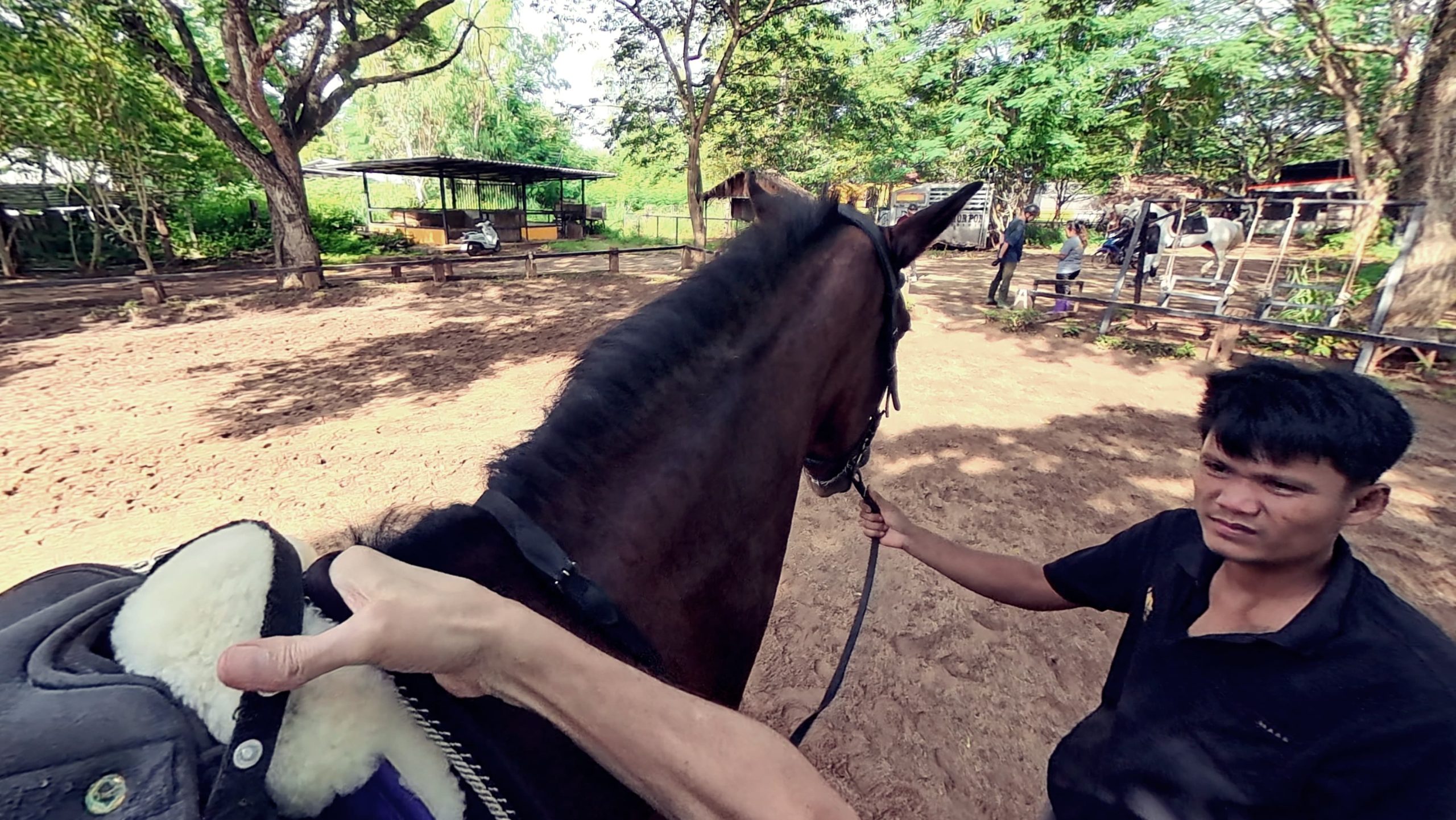
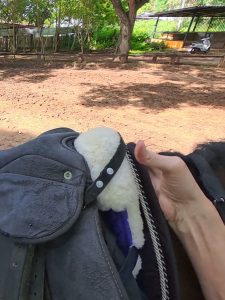
    Take a couple of steps back and look at the saddle from the side. The seat should look level and centered. If the back slopes downward toward the tail, your weight will dig painfully into the horse’s loins; if it tilts upward in front, you’ll be thrown backward while the pommel pinches the withers. Next, check for shoulder room: slide your flat hand under the front edge of the saddle, just behind the shoulder blade. You should be able to slide your fingers in comfortably without your hand being pinched. Many trail horses and native ponies have compact backs, and saddles are often placed too far forward. Your horse needs room for its shoulder blade to rotate backward freely with every stride, without bumping into the rigid front edge of the saddle tree. 

    Field Check: Place your hand flat in the deepest part of the seat. The lowest point should sit directly over the horse’s middle ribs, well clear of the unsupported lower back where the ribs end. 

    4. Tenting the Pad and Checking Wither Clearance 

    Now look directly at the pommel at the front of the saddle. A properly placed pad should be tented—pulled straight up into the front gullet of the saddle before the girth is tightened so air can circulate along the spine. If the pad is pulled flat and tight across the withers, it acts like a bowstring, sawing against the skin on every step. A pad that has pulled flat is usually a giveaway that the saddle was tacked too far forward or doesn’t fit the horse’s back. 

    With the pad tented, check your wither clearance: you should be able to slide two or three fingers comfortably between the top of the horse’s withers and the underside of the pommel (and pad). At the back, make sure the channel between the panels is wide enough that the saddle never touches the backbone directly. Be cautious if you see a yard stacking multiple thick blankets or heavy gel pads: that is usually an attempt to make a wide saddle sit on a narrow back, which traps heat and makes the saddle roll from side to side. 

    Field Check: Slide your fingers under the back corners of the saddle panels. The pressure against the horse’s back should feel smooth and even—never digging in sharply like a knuckle, and never lifting completely off the back. 

    5. Pad Materials in Tropical Heat 

    Take a moment to check the condition and material of the saddle pad. In high humidity, breathable natural materials like cotton or pure wool felt let heat and sweat escape far better than thick synthetic fleece or heavy neoprene, which trap boiling heat against the muscles. Ensure the pad extends symmetrically on both sides with no folded edges, wrinkles, or bunched corners trapped under the panels. A pad that is stiffened with dried sweat from previous rides will act like sandpaper against warm skin once the horse begins to work. If a pad feels crusty, stiff, or damp before you even start, simply ask your guide for a fresh, clean one—a caring yard will happily swap it out. 

    Field Check: Run your finger along the front binding of the pad. Stiff synthetic piping or thick seams trapped directly under the front saddle points can create sore spots on a long, downhill trail. 

    6. Girth Fit and Balance 

    Always check the girth yourself. Slide your flat hand between the girth and the horse’s side just behind the elbow: you should feel a comfortable, snug fit—enough give for two fingers, but not loose enough to roll. It should never be tightened so fiercely that the horse cannot expand its chest to breathe. Check that the girth is buckled evenly on both sides. If one side is buckled on the bottom hole and the other is pulled to the very top, the saddle is being pulled crooked. Horses often tighten their belly muscles when first tacked up out of habit. Once you walk thirty yards, they relax and exhale, and the girth will usually take up another hole cleanly. 

    Field Check: Notice the girth material. In high humidity, smooth leather or ventilated waffle-weave girths wipe clean and prevent skin rubs. Unwashed, sweat-stiffened cotton girths will quickly cause painful friction rubs against warm skin. 

    7. Bridle, Bit, and Reins 

    Look for symmetry in the bridle. The bit should sit level in the mouth, resting comfortably at the corners of the lips with one or two soft, relaxed wrinkles—not pulled up into a tight grin, and not hanging so low it bangs the teeth. Gently slide the bit side to side to ensure it moves freely without pinching the cheeks or tongue. Check the noseband: you should be able to slip two stacked fingers easily underneath so the horse can lick, chew, and swallow comfortably. The throatlatch under the jaw should be loose enough to fit four fingers so it doesn’t press against the windpipe when the horse lowers its neck. Finally, trace your reins from your hands straight down to the bit to make sure they aren’t twisted or tangled in other straps. 

    Safety Check: Give the leather loops or buckles where the reins connect to the bit rings a quick, firm tug. In tropical humidity, rein ends absorb sweat and saliva; verifying that the stitching is tight and the fasteners are secure ensures you won’t face a detached rein on a steep downhill trail. 

    8. Asking Your Guide the Right Questions 

    Good guides love talking about their horses. Take a moment to ask a few practical questions that show you want to work with the horse’s personality: “How does he like to be ridden—does he prefer a light, loose rein, or does he like steady contact?” “Is he happiest at the front of the group, or does he prefer following behind another horse?” “Does he mind passing water buffalo or motorbikes, or does he look at things along the trail?” These aren’t test questions; they are how you learn your partner’s habits before you leave the yard. 

    Guide Tip: Ask about the ride home: “Does he speed up or get marchy when we turn back toward the barn?” Knowing this in advance helps you stay relaxed and use your seat and balance to manage the pace, rather than getting into a tug-of-war with the reins. 

    9. Stirrup Length and Leather Safety 

    Never head out with stirrups left at someone else’s length. The classic trick of measuring the stirrup against your arm gives you a starting point, but on a trail ride, it usually falls a couple of inches short. For long hours outdoors, you want a comfortable, shock-absorbing length: long enough to let your legs drape naturally around the horse’s barrel, yet short enough that you can easily stand in a light two-point seat to relieve your horse’s back on steep climbs. 

    If the leathers run out of holes and leave you feeling cramped, do not just accept it and ride with your knees bent up like a jockey. Riding for hours with your stirrups too short puts excruciating torque on your knees and hips. Simply ask your guide or groom for a longer pair of leathers before you leave the yard—it takes two minutes to swap them over. While adjusting, give the leather a quick check: make sure the stitching around the buckles is tight and the holes aren’t stretched or tearing. If the stirrup irons feel narrow on your boots, ask for a wider pair; you want half an inch of room on either side so your foot can never get caught. 

    Field Check: Check the stirrup treads. If riding with safety cage stirrups or wide endurance pads, make sure they are clear of dried mud so your boots sit level and release freely if needed. 

    10. The Walk-Away and Final Check 

    Whenever possible, use a mounting block, a solid rock, or a bank to get on. Mounting from a block protects your horse’s back and keeps the saddle from pulling sideways. Once in the saddle, sit quietly for five or ten seconds before asking for a walk. Walk your horse thirty yards around the yard. Use this rolling walk to feel what you couldn’t see from the ground: Does the saddle roll or tilt? Does the horse step out freely through its shoulders, or does it feel stiff and hesitant? Stop quietly, reach down, and feel the girth again. Almost always, you will find the girth has loosened and can take up one more hole smoothly. 

    Field Check: If the saddle feels crooked or slips during those first thirty yards, get off and straighten it now. Fixing it on flat ground in the yard takes thirty seconds; trying to adjust a slipping saddle on a narrow, muddy jungle path is an avoidable risk. 

    A Culture of Collaboration 

    A confident rider approaches a pre-mount check with warmth and curiosity, never suspicion. Asking a guide, “He seems a little sensitive around the girth today—does he prefer an easy, unhurried walk to settle in?” or “Do you mind if I take the girth up a notch on the off-side to keep the saddle centered?” invites the local team into a shared conversation rather than an audit. If a genuine welfare or tack concern is brushed aside, it is completely reasonable to pause or ask for a different horse. A good operator will never take that personally; they will respect a guest who rides with quiet, observant horsemanship. 

    Great stables across Asia are deeply proud of their horses and love welcoming guests who appreciate the craft. Taking those few unhurried minutes before mounting shows respect for the local team, protects the horse beneath you, and sets the stage for a wonderful ride.